Posts sobre cultura

John Gruber sobre a existência dos cinemas

John Gruber, no Daring Fireball, comentando sobre a compra da Warner Bros. pelo Netflix:

The LA Times article goes on to cite concerns from the movie theater industry, based on Netflix’s historic antipathy toward theatrical releases for its films. Netflix is promising to keep Warner Bros.’s film studio a separate operation, maintaining the studio’s current support for theatrical releases. I hope they do. I grew up loving going to the movies. I still enjoy it, but the truth is I go far less often as the years go on. Movie theaters shouldn’t be a protected class of business just because there’s so much affection and nostalgia for them. If they continue sliding into irrelevance, so be it. That’s how disruption, progress, and competition work.

Eu acho tristíssima essa observação, porque ignora o aspecto cultural do cinema como um espaço de comunidade, de acesso à arte na forma mais apropriada pra experimentar ela. Se eu posso ver um filme no Netflix, e o Netflix faz mais dinheiro que uma sala de cinema, o Netflix é mais bem sucedido em exibir aquele filme? É como argumentar que, agora que eu posso olhar pra Mona Lisa na Wikipédia, o Louvre não tem mais razão de existir.

A magia do StreetPass

Merrit K, VGBees:

Why have we turned away from the light of local multiplayer and the beauty of fleeting social gaming connections in an era when more people than ever own devices capable of wifi and Bluetooth communication?

Maybe we don’t want to be connected to those around us. The pandemic didn’t help, to be certain, but the trend away from the developments of the early 2010s started long before it hit. The Streetpass LED on the 3DS, an early form of notification, was a joyful signal. Today, we’re bombarded with notifications and alerts, and many of us have grown weary of them. In theory, modern smartphones could support apps with Streetpass-like features, and location-based dating apps are somewhat similar. But that experience of delight at connecting with another player likely wouldn’t be there because of how ubiquitous the hardware has become.

As both millennials who grew up with the internet and watched it transform and zoomers who have only ever known it in its current, centralized and corporatized mode are beginning to reevaluate their relationships to personal technologies, perhaps now is the time to rediscover what has been lost.

Halt and Catch Fire entende os videogames

Devan Suber, para a Polygon:

The much-beloved AMC show made no secret of the fact that it was never really about the technology covered in a season; in the words of Joe MacMillan (Lee Pace), the computer was always “the thing that gets us to the thing,” a vector for connection, expression, or some other deeper human need.

Uma encapsulação perfeita de uma das minhas séries favoritas. Halt and Catch Fire sempre capturou muito bem seus personagens como os desbravadores do início da computação pessoal: querendo criar tecnologia para conexão e expressão, e a empolgação deles de encontrar aquela nova fronteira – como se fosse a criação de um novo idioma, a descoberta de um novo continente. Já dá vontade de rever.

O legado sem limites de Breath of the Wild

Algumas passagens do texto do Lewis Gordon para o The Ringer:

On the one hand, a sense of adventure that has few peers in video games: wanderlust, dread, the sublime, all achieved within a vast, meticulously designed open world. On the other, systems and mechanics that combine in such a way that they both react physically to the player and seem to exist independently of them, alternately inspiring awe and glee and making a virtual setting feel truly alive.

By the mid-2010s, Ubisoft’s icon-filled open-world “map games” (a pejorative term expressing players’ frustration with having to scour a map to find things to do rather than looking at the world itself) had reached their logical extremes

[…]

At their most cynical, these ballooning virtual spaces appeared less like living, breathing worlds than sites to consume ever more content.

Breath of the Wild was born from a crystalline picture: Link climbing a cliff before paragliding to the ground below, moving seamlessly from rock to air, and then, finally, landing comfortably on terra firma. There was more, though: survival and what director Hidemaro Fujibayashi called the “creativity of combination”—for example, lighting wood with fire to create a larger bonfire. The Zelda series, whose game mechanics were usually so precise and predictable, would open itself up to the natural elements. In the process, it would have to embrace a degree of chaos and chance.

Central to the game’s production was figuring out how such a world should behave. After all, a space that lacks consequence, friction, or discord is arguably one without life.

What Nintendo’s game gave Kythreotis, beyond direction about how this mechanic should function, was a sense of belief—not just in himself and Fineberg, but in the player, who with expanded input would become more of a “collaborator in the experience.”

Maybe Breath of the Wild is the Platonic ideal of a type of action game that almost everyone who has ever picked up a controller has envisioned: one in which a lone warrior explores a mythic landscape that responds to their actions in a meaningful way. […] Perhaps because Nintendo operates according to its own set of rules, forgoing the graphical arms race to focus on design, it was able to burrow deeper than anyone else into the systems that bring such a game to life. As Kythreotis stresses, “Zelda is never trying to be a film. It wants to tell its story through systems and mechanics. It embraces video games as a form.”

O Assassino é “sigma cinema”

Max Read:

The killer thinks of himself as having an unmatched clarity about his life and the world, but the movie mostly regards him as self-deluded. He botches his hits, he forms attachments, he misunderstands his own importance. Rather than being freed by his careful planning and elaborately articulated life philosophy, he’s trapped by his own paranoias and resentments.

“The killer as sigma male” is obviously not the only way to read this movie; as suggested in the footnotes you could see it as an personal story about a fastidious craftsman learning his own limits, or also a movie about how annoying work is, especially as a contractor. (To quote the killer’s favorite band: “this position I’ve held/It pays my way and it corrodes my soul.”)

But I like the sigma male reading because it reminds us that throughout his career Fincher has been in dialogue with the concerns of 4chan and the rest of Loser Internet

To be clear, I don’t think that Fincher is endorsing these ideas, specifically–except for goth gf–just that he’s interested in exploring them and the kinds of characters who believe them.What’s particularly interesting for such an internet-y set of ideas is that Fincher doesn’t really make movies “about” the internet–even The Social Network was a lot more about ambition, sociopathy, and freak loners than it was about “the internet,” per se. Instead, he made a body of work around a set of broad social (and gender) anxieties that have been particularly shaped by digital culture.

More to the point, it reminds us that the killer and his sociopathic boorishness live in the same tech-wrecked world as the rest of us.

What we get instead of “action,” it turns out, is a lot of travel and logistical work, which suggests that the funniest way to read the movie is “autobiographically”: it is, after all, roughly two hours of an meticulous and obsessive freak planning and executing a tightly scheduled multi-city production.

As contradições no cerne de Assassinos da Lua de Flores

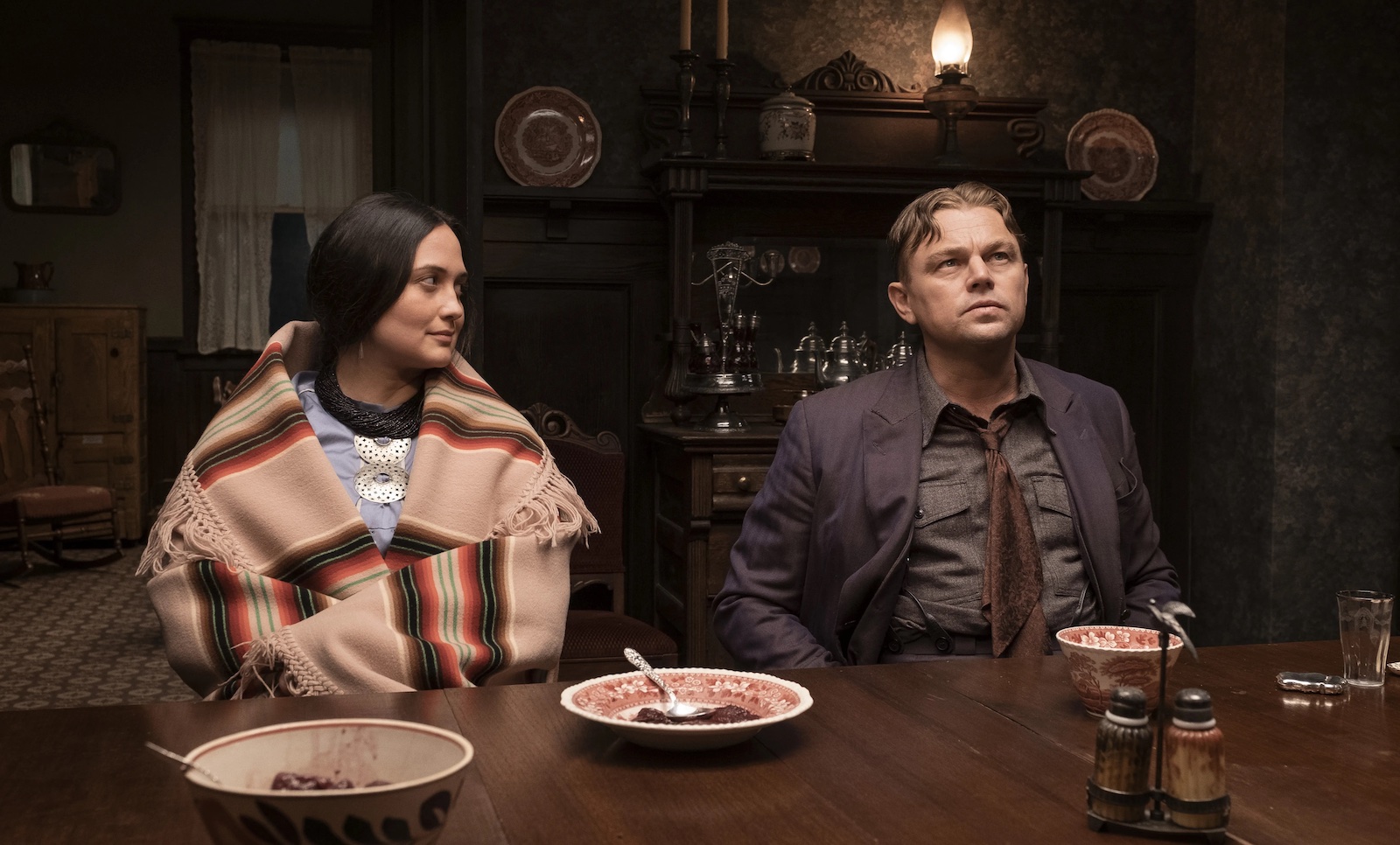
Soraya Roberts, no Defector:

The reason I keep thinking of that storm scene is because there seems to be a collective inability in our culture to sit in silence without saying something reflexively, particularly when that silence is pregnant with the kind of contradiction art is meant to produce. I know social media doesn’t exactly promote reticence or nuance of any kind, but this appears to be something more widespread. The compulsion to assess films, television series, music, books, anything, really, based on whether they are moral has leaked out of conservative enclaves into the mainstream. And just as equating the art with the artist has always struck me as a strange reduction, so too is equating the politics with the art

It’s hard to parse where this need for prescriptive morality comes from, particularly since prescription is the opposite of art’s intention. Art is intended to provoke questions, not provide answers. This new requirement for clear direction seems to have emerged not just from a culture which is in a constant panic over the prospect of being canceled—no matter how nebulous that threat is—but is also of a piece with the less abstract, more technical processing of art you find in fandom circles. These are places where explicit parameters must be set forth within which the audience then feels permitted to operate. This is an audience that needs rules, or else it doesn’t know how to react.

To read art is to be read by it. And the types who censor art are always the last to look in the mirror.

Eles não nos querem e nós não precisamos deles

David Roth, Defector:

The vague but ominous disruption promised by artificial intelligence fogs this process, justifying where it needs to justify and serving as a sort of jeering threat everywhere else; that this AI doesn’t yet really do anything well, and has the unfortunate habit of eating its own excrement until it goes insane, has not really damped this cohort’s enthusiasm for it. Which fits, because that appeal is more ideological and aspirational than practical. What all of these businesses—creative industries, social media platforms, online commerce—have in common is that they need people. They need people to make them, and they need other people to pay attention to them. The super-class that sits atop all this, gloating, does not like that very much.

Como as tirinhas salvaram a minha vida

É cansativo viver em 2019. Nunca tivemos tanto poder sobre a informação — podemos aprender sobre qualquer coisa e podemos estar a par de qualquer notícia a qualquer momento — e, enquanto isso é bom para a maior parte, eu acho que teve alguns efeitos colaterais estranhos em minha mente. É fácil se perder nesse acesso infinito. Podemos ter a ilusão de que sabemos tudo ou que podemos saber tudo. Assim, abraçamos a crença de que as injustiças podem ser desfeitas e verdades objetivas são o cerne das regras em que vivemos. Mas ter essa quantidade de informações também deixa claro que não podemos consertar todos os problemas deste mundo e que, como por mais que discutamos, brigamos e ficamos com raiva na internet, as coisas não vão ficar bem no final do dia, porque do outro lado da seção de comentários há outro ser vivo, que teoricamente tem tanto acesso à informação quanto você, e mesmo assim ainda pensa diferente. A era em que vivemos nos torna conscientes do estado do mundo, e ele não vai bem, e nos pede para fazer algo sobre isso. Mas também nos torna conscientes de quão pequenos somos, como só podemos realizar um certo tanto, e como essa lacuna entre o que deve ser feito e o que podemos fazer é maior do que nossos comentários irritados na internet fazem parecer.

Eu vivi no meio de uma depressão nos últimos dois anos, e é uma luta constante para encontrar um significado para a vida. Não o Sentido da Vida, aquele grande desconhecido da existência humana, mas um significado para acordar de manhã, fazer algum trabalho, pegar algo para comer e dormir novamente. Parecia egoísta para mim, estar perdido em minha própria mente e em meu próprio conflito interno enquanto o mundo desmorona. Como eu poderia encontrar um lugar no mundo se eu não sei se ele vai estar lá se eu conseguisse sair dessa algum dia?

Esses últimos dois anos me fizeram reconsiderar muito. O que eu fiz com a minha vida, o que eu acreditava ser meus sonhos e o que eu deveria esperar de mim mesmo. Ainda há alguns dias que eu acordo e luto para entender um pouco disso tudo. Eu também tive um bom tempo para considerar o que aconteceu com a Internet, porque muito de mim, minha própria existência e talvez de toda a minha geração existe não apenas neste mundo agonizante, mas também nesta tela brilhante que adorávamos porque nós podíamos ser nós mesmos, e agora odiamos, porque o que revelou sobre nós mesmos não era tão bom assim. Eu vi como o Facebook e o Twitter e o Medium e o YouTube e etc. transformou notícias e informações em um sistema de gamificação, onde havia dois lados, o certo e o errado, os vencedores e os perdedores, e deveríamos lutar uns contra os outros para que pudéssemos ganhar essa pequena dose de dopamina quando conseguíamos aquela Curtida contra essa outra pessoa que estava errada. Isso nos deixou amargos, nos deixou mais irritados.

Como eu disse, cansativo.

Então, como eu poderia encontrar significado, ou pelo menos tentar desempacotar tudo isso, na bagunça em que vivemos agora? Como eu poderia sair daquele casulo de autodestruição sem querer voltar a ele no momento em que visse como é a extinção? Bem, eu comecei a ler tirinhas.
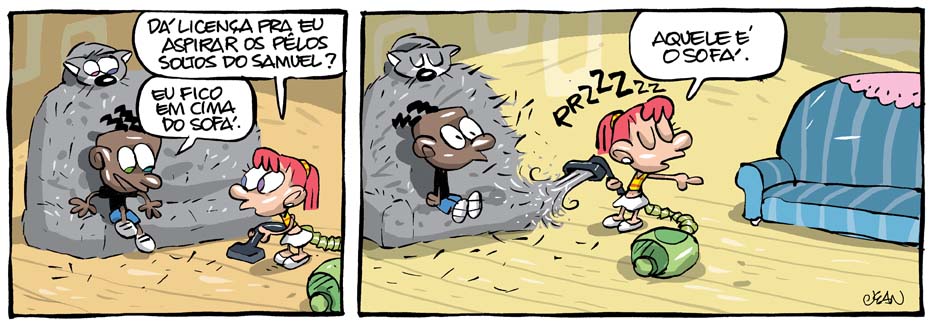
Animatiras, por Jean Galvão

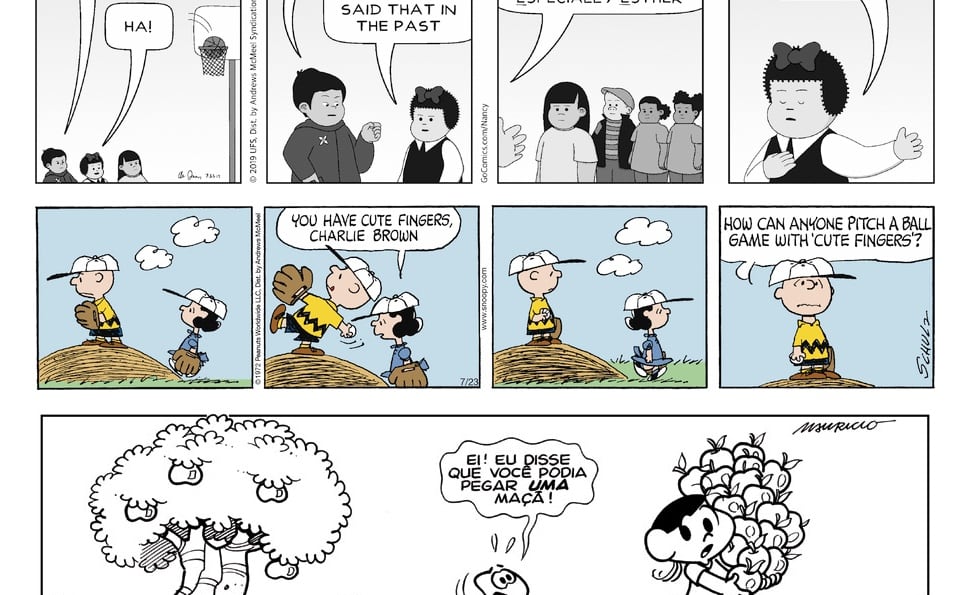
Meu primeiro contato com tirinhas aconteceu na Revista Recreio. Eu comprava a revista por causa dos Letronix, e nunca lia as matérias da revista porque eram longas demais e eu ficava cansado, mas na última página da revista tinha uma seção de tiras. A minha favorita era a Animatiras, do Jean Galvão. O personagem principal era o Tuneba (vocês não sabem a alegria que eu tive planejando esse post de descobrir que eu lembrava o nome dele), mas o grupo de amigos era extenso. A página também me apresentou aos clássicos, e a partir dela eu conheci a Mafalda, o Calvin e Haroldo e a minha grande paixão até hoje, Peanuts.

Eu não sei o que me levou a parar de ler tirinhas, mas provavelmente foi porque existe muito conteúdo na internet, e a gente sempre acaba substituindo algo por outra coisa. Por muito tempo eu ligava meu computador pra começar a trabalhar pela manhã e a primeira coisa que eu fazia era ler alguns tuítes. Nos últimos anos isso me fazia mais mal do que bem, e então eu voltei a adotar o leitor de RSS, essa tecnologia de dinossauro. Além de uns blogs que eu sempre gostei de ler e um ou outro colunista de jornal, eu lembrei como era bom ler Peanuts de manhã, então comecei a assinar o feed de tirinhas. É como se fosse um jornal: todo o dia pela manhã, em meio aos posts que eu leio, há quatro quadros com a turma do Charlie Brown tentando resolver algum problema, ou simplesmente se deparando com um, e aprendendo a viver com ele.

Outros autores mais inteligentes são capazes de explicar a genialidade desse formato. Umberto Eco, por exemplo, era o maior fã de Peanuts. Para mim, resta apenas dizer que ver que esse confronto dos últimos anos não é algo exclusivo meu, mas sim o cotidiano de todo o mundo, aparentemente. A natureza fechada desses pequenos quadros diários não me permite mergulhar na melancolia de Charlie Brown ou no medo do Calvin, mas me permite olhar para eles e ver que sim, mais alguém passou por isso. Não existem muitas soluções para os problemas dos personagens dessas tirinhas. A gente nunca sentiu tanto o peso do mundo nas nossas costas como agora, a pressão de fazer algo porque o tempo tá acabando ao mesmo tempo em que a gente precisa dar um jeito na nossa vida. O que Peanuts e Mafalda e Nancy me lembram, um pouco todos os dias, é que nem sempre a gente vai conseguir dar um jeito. Mas a vida continua, e na manhã seguinte o Snoopy vai escrever mais uma página do seu grande romance.

A simplicidade de uma tirinha — alguns poucos quadros, um acontecimento simples, e as vezes uma piada — é revigorante nesse rio eterno de informação que a gente vive hoje em dia. Episódios de séries estão cada vez maiores, franquias de cinema não acabam nunca. Um artigo sobre o último tuíte do Bolsonaro faz a gente se sentir tão mal que a gente passa vinte minutos lendo ele aos poucos. Saber se o Snoopy vai conseguir derrubar Woodstock do galho demora vinte segundos, mas traz uma finalidade. Essa simplicidade também esconde o que as tirinhas parecem fazer de melhor pra mim: refletir um pouco o constante desafio que é viver o cotidiano, se deparar com obstáculos grande demais. Da falta que uma mãe faz para seu filho à frustração de não ser bom o suficiente naquilo que você queria ser excelente. No meio de tanta coisa que vai contra esses personagens, o que dá a eles a força para seguir em frente?

Seja Charlie Brown encarando seu fracasso ou a Mônica aprendendo a lidar com o ego, esses personagens enfrentam o cotidiano de uma forma semelhante a nossa: um pouquinho a cada dia. As tirinhas são um espaço curto para Grandes Declarações da Humanidade, então elas trabalham muito mais em refletir algo eventual, e isso acaba criando uma aproximação nossa com os acontecimentos da vida desses personagens, que geralmente são coisas pequenas, nada excepcionais. Como no nosso dia-a-dia, onde a gente enfrenta não só os nossos conflitos internos constantemente, mas também essa e aquela tarefa do cotidiano. Então a gente dorme, acorda no outro dia, e encontra elas de novo.
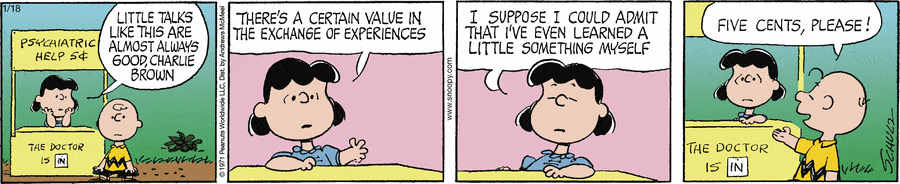
Peanuts, por Charles M. Schulz

Não digo que esse foi o antídoto da minha tristeza, e nem que essa é a solução definitiva para os problemas do mundo. Mas encontrar conforto num breve momento de empatia com o outro todos os dias ajudou a me deixar saudável, e a querer ficar saudável para seguir em frente. Isso eventualmente me ajudou a escrever mais, a me preocupar mais comigo mesmo e com as pessoas ao meu redor e, o mais importante, me fez aprender a apreciar esses breves momentos de uma introspecção repentina que acontece, seja na hora de lavar a louça ou quando a gente sai do ônibus e um carro passa e nos encharca com a água da rua. Apreciar esses pequenos momentos no papel me fez ver eles de uma nova forma na vida real. É algo que eu pretendo levar no meu dia-a-dia daqui pra frente.